Restaurant POS Malaysia: Features That Matter Most for F&B Owners
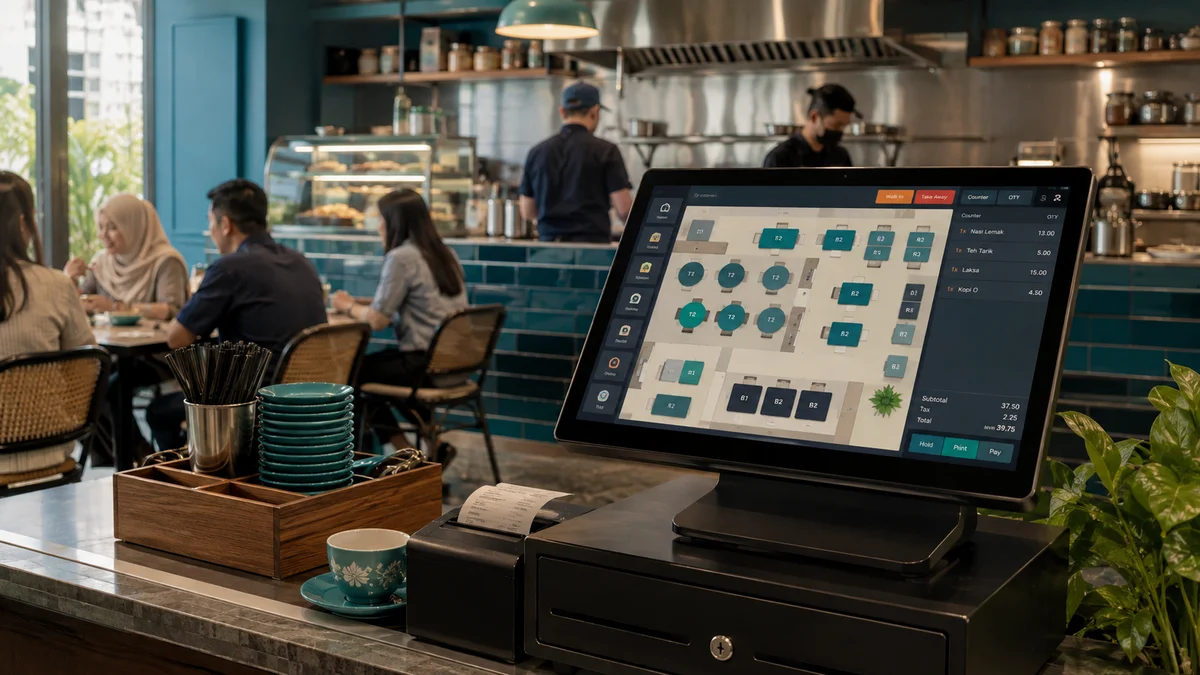
A restaurant POS is not just a till that prints receipts. For an F&B owner in Malaysia, the features that actually move the needle on profit and sanity are the ones that connect the front counter to the kitchen and to your stock. Here's what matters most, roughly in order.
1. Kitchen display, not paper chits
Handwritten chits get misread, dropped, and fired out of sequence during a rush — which means wrong dishes and slow tables exactly when you can least afford it. A POS that sends orders straight to a kitchen display screen, in the right order, removes that whole class of error. Look for one that shows order timing so the kitchen can see which tickets are ageing.
2. Ingredient-level (recipe) stock tracking
Counting stock by eye doesn't scale past a small menu. A POS that knows each dish's recipe deducts ingredients automatically as dishes sell, so you get a low-stock alert on chicken or gula before service, not after you've run out mid-lunch. It also tells you the difference between theoretical and counted stock — which is where wastage and pilferage show up.
3. Recipe and menu costing
This is the feature most basic POS systems skip, and it's the one that protects your margin. If each recipe is costed at ingredient level, the POS shows your true food cost and gross margin per dish. That's how you spot the popular item that barely breaks even after cost — the one keeping the kitchen busy while the P&L stays thin.
4. One flow for dine-in, takeaway and delivery
Malaysian F&B runs on all three channels at once. The POS should handle table service, tapau, and delivery orders in a single flow, with the kitchen seeing them together in priority order rather than staff juggling separate systems.
5. Modifiers and set meals done properly
"Less spicy," "no onion," "add cheese," combo sets — these need to flow to the kitchen clearly and, for combos, deduct stock by their component recipes. A POS that fudges modifiers creates kitchen confusion and breaks your stock accuracy.
6. Sales reporting by dish and by hour
Daily totals tell you almost nothing. Reporting by dish, by hour, by channel and by staff tells you what to prep, when to roster, which promotions worked, and which menu items to fix or cut. This is the difference between a POS and a genuine management tool.
7. Malaysia-specific basics
- SST-compliant receipts and reporting if you're registered.
- Cash, card and DuitNow QR at the counter.
- Offline mode — checkout and kitchen printing keep working if the line drops, then sync when it's back. Service should never stop because the internet did.
- Standard hardware — it should run on common tablets/terminals and printers, not lock you into proprietary devices.
8. Multi-outlet, if that's the plan
If you run or plan more than one outlet, check for central menu and recipe management (change a price once, everywhere) and combined reporting. Otherwise each outlet becomes an island someone has to reconcile by hand.
Features that sound good but rarely matter early
- Elaborate loyalty programmes — useful later, not a launch priority.
- Reservation modules — only if reservations are core to your format.
- Deep third-party integrations — nice, but confirm the basics work first.
What it costs
A single-outlet restaurant system with POS, kitchen display, ingredient-level stock and margin reporting starts from around RM2,499. Multi-outlet with central menu management runs from around RM5,999 for up to five outlets. Hardware is usually additional but often works with what you have.
Where to go from here
If you're firing orders on paper or guessing at your food cost, those two are the highest-value fixes. See our Restaurant Management System page, or the POS & Retail Management page if your operation is more retail than kitchen.
ZAMAN IT Team
Web & Software Development, Kuala Lumpur
Written by the ZAMAN IT team, drawing on client work across websites, AI chatbots, business software and digital marketing since 2008.
Practical guidance, Malaysia-specific
Real pricing, real trade-offs, written for people running a business here.