WhatsApp AI Chatbot for Malaysia: A Practical Overview
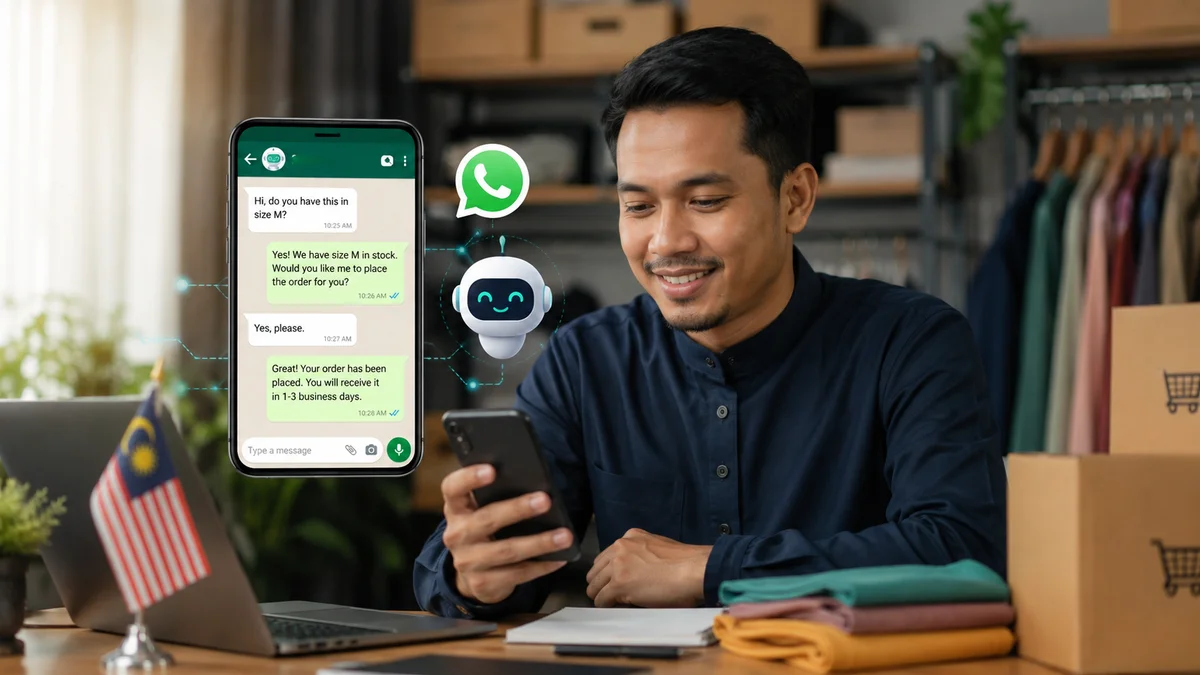
WhatsApp is where most Malaysian customers already message a business — not a contact form, not email. That makes it the obvious place to automate customer conversations, but "WhatsApp chatbot" covers a wide range of things, from a single fixed auto-reply to a genuinely conversational AI system. This overview explains what a WhatsApp AI chatbot actually does, what it costs, and where it does and doesn't make sense.
What a WhatsApp AI chatbot actually is
A basic WhatsApp auto-reply sends the same message regardless of what's asked — useful for an "we're closed, we'll reply during business hours" notice, but not much else. A WhatsApp AI chatbot is different: it's connected to the WhatsApp Business API, trained on your specific business information (products, pricing, policies, FAQs), and able to understand the actual question being asked well enough to give a relevant, specific answer — then hand the conversation to a real person the moment it's needed.
What it can realistically handle
- Pricing and product availability questions — the questions that repeat dozens of times a day for many businesses.
- Order status enquiries — "where's my order" answered instantly instead of a staff member checking manually.
- Appointment or booking questions — availability, what to bring, how to reschedule.
- Basic troubleshooting or policy questions — return policy, warranty terms, opening hours.
- Initial lead qualification — asking what a prospect needs before a salesperson gets involved.
What it shouldn't try to handle
A chatbot shouldn't be the final word on a complaint, a price negotiation, or anything emotionally charged — those need a person, and a well-built chatbot recognises this and hands off immediately rather than trying to resolve everything itself. It also shouldn't pretend to be a human; being upfront about being an automated assistant, with an easy path to a real person, keeps trust intact.
How it actually works, step by step
- Business information handover. You provide your FAQs, pricing, and key policies — this becomes the chatbot's knowledge base. The more specific this is, the more accurate the chatbot's answers will be.
- WhatsApp Business API connection. The chatbot connects to your WhatsApp Business number. If you don't already have API access, this gets set up as part of onboarding.
- Testing against real conversation patterns. Before going live, the chatbot is tested against the kinds of questions your business actually gets, not generic examples.
- Go live, with close monitoring early on. The first weeks matter most — real customer questions surface gaps in the training data that get fixed quickly.
What it costs in Malaysia
Pricing for a WhatsApp AI chatbot in Malaysia typically includes a setup fee — covering the initial training, API connection, and testing — plus a monthly fee that scales with conversation volume. As a general benchmark, expect setup from around RM1,999 and monthly fees from around RM399 for a few hundred conversations a month, scaling up for higher volume or additional integrations like live order-status lookups.
Bahasa Malaysia and mixed-language conversations
A chatbot built specifically for the Malaysian market needs to handle conversations that mix English and Bahasa Malaysia in the same message — which is how many customers actually type. A chatbot trained only on English will misunderstand or fail to respond naturally to this, so this should be confirmed before choosing a provider.
Common mistakes when launching one
- Training it on too little information, so it can't answer basic questions confidently and constantly falls back to "let me connect you to our team" — which defeats the purpose.
- Not testing it against real past conversations before launch, so obvious gaps only surface once customers hit them.
- No clear human handoff path, leaving frustrated customers stuck in a loop with no way to reach a person.
- Treating it as "set and forget" rather than reviewing conversation logs periodically to correct and improve its answers.
How to tell if your business is ready for one
A WhatsApp AI chatbot makes the most sense when a business already gets a meaningful volume of repetitive WhatsApp enquiries — enough that a real amount of staff time goes into answering the same handful of questions. If your WhatsApp volume is still low, the setup cost may not be justified yet; a simpler auto-reply might cover you until volume grows.
Where to go from here
If repetitive WhatsApp questions are taking up staff time, or you're regularly missing after-hours enquiries, it's worth working out roughly how many conversations a month you're dealing with — that number determines which package actually makes sense. See our WhatsApp AI Chatbot page for package pricing and what's included at each tier.
ZAMAN IT Team
Web & Software Development, Kuala Lumpur
Written by the ZAMAN IT team, drawing on client work across websites, AI chatbots, business software and digital marketing since 2008.
Related services
Practical guidance, Malaysia-specific
Real pricing, real trade-offs, written for people running a business here.